Advertising disclosure. MaxHealthSup is an affiliate-supported website. If you buy through links on this page we may earn a commission, at no extra cost to you. We are not the manufacturer or the seller of this product, we have no relationship with the company beyond that affiliate arrangement, and we have not independently tested or laboratory-verified it. What follows is an editorial review of the product information the manufacturer publishes, plus general information about the ingredients it contains.
Mineral supplement · Ingredient review
Zinc7 Review: Does "Seven Forms of Zinc" Actually Matter?
Zinc7 by True Cellular Formulas delivers 50 mg of elemental zinc from seven different compounds. This review covers whether using seven forms has any established advantage, why that dose sits above the recognised safe upper limit for daily long-term use, and the copper and antibiotic interactions you need to know about. We have not tested this product.
Affiliate link · opens the manufacturer's website. Confirm current pricing, the label and return terms there before ordering — they are set by the seller, not by us.
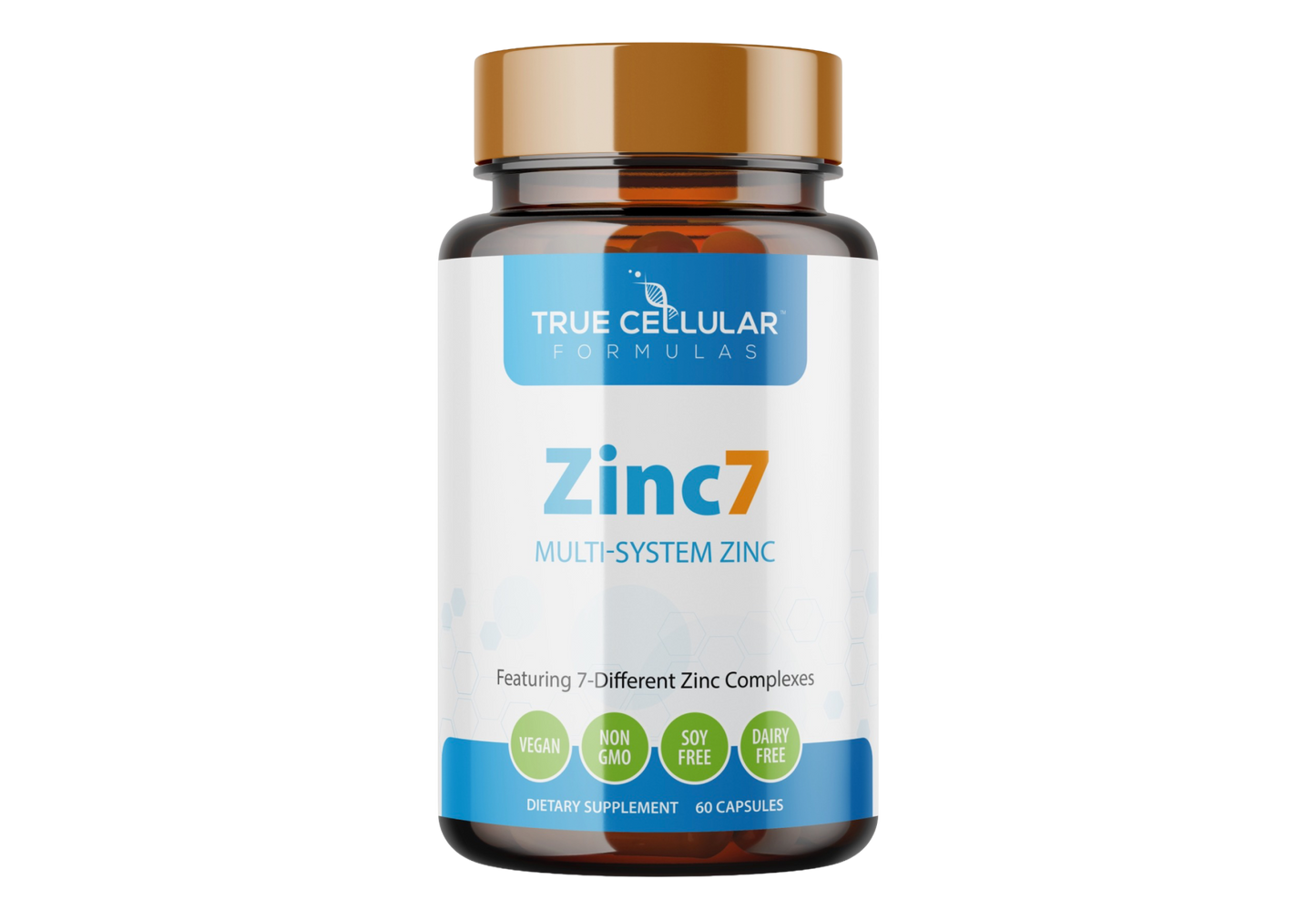
Product image published by the manufacturer.
How we assessed this product
This is desk research. We read the label information and claims the manufacturer publishes, and looked at what is established about zinc supplementation, the different zinc compounds, and the recognised intake limits. We received no samples, ran no laboratory tests and surveyed no users.
We do not publish star ratings on supplements. A score implies a measurement we have not made.
Quick facts
Product
Zinc7, by True Cellular Formulas (Allison Park, Pennsylvania)
Format
Capsule — plant-derived HPMC. 60 capsules per bottle, 2 capsules daily, so a 30-day supply
Dose
50 mg elemental zinc per serving — 455% of the Daily Value
The seven forms
Zinc citrate, ascorbate, glycinate, picolinate, methionate, orotate and acetate
Price at time of writing
1 bottle $69 · 3 bottles $147 ($49 per bottle) · 3-bottle special pack ("Buy 1, Get 2 Free") $69 (about $23 per bottle). Shipping is extra. Verify current pricing on the official site
Returns
The seller advertises a 60-day money-back guarantee, administered by the seller. Read the applicable terms before purchasing
Do not take without medical advice if
You take antibiotics or any regular prescription medication, are pregnant or nursing, or already take another zinc-containing supplement or multivitamin
The dose is the story here
Most reviews of this product focus on the seven forms. We think the more important number is 50 mg.
The recommended daily allowance for zinc is 11 mg for adult men and 8 mg for adult women. The tolerable upper intake level — the ceiling that expert bodies set for routine long-term daily intake from all sources combined — is 40 mg for adults. Zinc7 provides 50 mg per serving, before whatever you get from food and from any multivitamin you may also be taking.
That is not automatically dangerous. Doses in this range are used deliberately, for short periods, under supervision, and some people have conditions that warrant them. But 50 mg taken daily and indefinitely, without a blood test establishing that you need it, is a different proposition from a corrective dose. The main consequence of sustained high zinc intake is copper depletion, because the two minerals compete for absorption and high zinc induces a protein in the gut that binds copper and carries it out. Copper deficiency causes anaemia and, if it goes on long enough, neurological problems that are not always fully reversible.
Some formulas at this dose include a small amount of copper to offset that. From the information the manufacturer publishes, this one does not appear to. If you plan to take a 50 mg zinc product for more than a few weeks, that is the specific thing to raise with your doctor.
So does using seven forms do anything?
The marketing premise is that different zinc compounds are absorbed through different pathways, so combining seven gives more complete uptake than any single form. It sounds plausible, and it is the kind of claim that is difficult to disprove, which is part of why it works as marketing.
What the evidence actually supports is narrower. Zinc bioavailability does differ between compounds: the amino acid chelates such as glycinate and picolinate, and the organic salts such as citrate and acetate, are generally better absorbed than zinc oxide, which is the cheap form found in many mass-market products. That much is reasonably well established.
What has not been demonstrated is that seven forms together outperform one well-chosen form at the same elemental dose. We are not aware of a published head-to-head trial testing that, and the manufacturer does not cite one. Zinc absorption is regulated by your body according to your zinc status — when you are replete, you absorb proportionally less regardless of the compound — which is a mechanism that works against the premise rather than for it.
Our read: the forms chosen here are good ones, and meaningfully better than zinc oxide. Seven of them is a formulation choice that is defensible but not evidence-backed as superior to, say, zinc glycinate alone. Treat "seven forms" as a reason to prefer this over a cheap oxide product, not as a proven advantage over other quality zinc supplements.
What zinc is genuinely good for
Immune function
The most established use, and the reason most people take zinc.
Evidence note: zinc deficiency clearly impairs immune function, and correcting it helps. Zinc lozenges started within 24 hours may modestly shorten a cold. Evidence that ongoing high-dose zinc prevents illness in well-nourished people is much weaker.
Skin, hair and nails
Zinc is involved in tissue repair and keratin formation, and deficiency shows up visibly.
Evidence note: zinc has been studied for acne with mixed but not negligible results. Hair loss from zinc deficiency improves when the deficiency is corrected. Hair loss from other causes does not.
Taste, smell and wound healing
Classic markers of low zinc status, and among the first things to improve when it is corrected.
Evidence note: well established in deficiency. Not a reason to supplement if your zinc status is normal.
Energy metabolism and hormones
Zinc is a cofactor in hundreds of enzymes, which is the basis of most broad claims made for it.
Evidence note: being a cofactor in many enzymes explains why deficiency causes wide-ranging problems. It does not follow that extra zinc improves those functions in someone who has enough.
The honest summary
Zinc is a genuinely useful supplement for people who are short of it, and deficiency is common enough to be worth checking — particularly in vegetarians and vegans, older adults, people with digestive conditions, and heavy drinkers. The forms used here are good. But the whole case for supplementing rests on whether you are deficient, which a blood test answers and a marketing page does not. At 50 mg daily above the recognised upper limit, this is a product to take deliberately for a reason, not a general wellness capsule to take indefinitely because it seems healthy.
Who this is for — and who should skip it
Might be worth considering if
A blood test has shown you are low in zinc, or your doctor has advised supplementing
You are in a group with elevated risk of low zinc — vegetarian or vegan diet, older adult, malabsorption condition — and have discussed it with a clinician
You want better-absorbed forms than the zinc oxide in most cheap supplements
You have checked that nothing else you take also contains zinc
Skip it, or speak to a doctor first, if
You already take a multivitamin — stacking it with this can push you well past the upper limit
You are taking a course of antibiotics. Zinc binds some common antibiotic classes in the gut and reduces their effect
You plan to take it indefinitely without any copper intake or monitoring
You are pregnant or nursing
You have no particular reason to think you are low in zinc. In that case this is an expensive way to exceed a safe ceiling
Interactions and safety
Copper. This is the main long-term concern at 50 mg daily. High zinc intake reduces copper absorption, and sustained copper depletion causes anaemia and neurological symptoms. If you intend to take this for more than a few weeks, discuss copper monitoring or a copper-containing product with your doctor.
Antibiotics. Zinc binds some commonly prescribed antibiotic classes in the gut and reduces how much of the drug you absorb. If you are prescribed an antibiotic, ask your pharmacist whether yours is affected and how far apart to take them — typically a gap of several hours — and tell your prescriber you are taking zinc.
Other medication. Zinc can also reduce the absorption of some other prescription medicines, so a pharmacist should check anything you take regularly. Iron and calcium supplements compete with zinc, so taking them together reduces the benefit of all three.
Immediate side effects. Nausea, a metallic taste and stomach upset are common when zinc is taken on an empty stomach at this dose. Taking it with food helps. Persistent nausea is a reason to stop rather than push through.
Show the label to your doctor or pharmacist before your first dose, especially if you take any regular medication. At 455% of the Daily Value this is a therapeutic dose, and it deserves to be treated as one.
Pros and cons
What we liked
The zinc forms used are well-absorbed ones, not cheap zinc oxide
The dose and forms are clearly disclosed — more transparency than most products we review
Established manufacturer with a real company address and a normal retail storefront
Plant-derived capsules, suitable for vegetarians
What gave us pause
50 mg exceeds the 40 mg tolerable upper intake level for adults
No copper included to offset long-term zinc-induced copper depletion
The "seven forms" premise is not supported by a head-to-head trial
Expensive per milligram of zinc compared with a single-form quality product
Easy to double up unintentionally if you also take a multivitamin
Price and returns
At the time of writing, the official site lists three purchase options. Each bottle is a 30-day supply at the labelled two-capsule serving, and shipping is charged on top of each price.
Official pricing · checked 11 September 2026
1 Bottle 30-day supply
$69 — $69 per bottle, plus shipping
3 Bottles 90-day supply
$147 — $49 per bottle, plus shipping
3-Bottle Special Pack 90-day supply · "Buy 1, Get 2 Free"
$69 — about $23 per bottle, plus shipping
At the single-bottle price, Zinc7 sits at the premium end of the zinc market — a quality single-form zinc glycinate typically costs a fraction of this. The three-bottle options bring the per-bottle cost down considerably, but they also mean 90 days at a 50 mg dose, which is exactly the kind of extended use we suggest discussing with your doctor first.
Whether the premium is worth it depends entirely on whether you accept the seven-forms premise, which as set out above is plausible but not demonstrated. The seller advertises a 60-day money-back guarantee, administered by the seller, not by us. Its published terms state that the guarantee covers up to two opened bottles and that any remaining bottles must be returned unopened. Read the applicable terms before purchasing and keep your order confirmation.
Affiliate link. Pricing above was accurate on 11 September 2026 and may have changed. Prices are set by the seller, not by us.
Sources and further reading
Independent references we used to check the ingredient and safety claims on this page. They describe the ingredients in general, not this specific product.
It is above the 40 mg tolerable upper intake level set for adults, which is the ceiling for routine long-term intake from all sources. Short courses at this level are used in practice, but taking it daily and indefinitely without medical input is not something we would suggest. The specific risk is copper depletion over months. Discuss it with your doctor, particularly if you plan to stay on it.
Can I take it with my multivitamin?
Check the multivitamin label first. Most contain zinc, and stacking them can put you substantially over the upper limit without you realising. If both contain zinc, take one or the other, not both.
Can I take it while on antibiotics?
Ask your pharmacist. Zinc reduces the absorption of some common antibiotics, and the fix is usually to separate the doses by several hours. The pharmacist can tell you whether your antibiotic is one of them and what gap to leave.
Do I need to take copper with it?
That is a question for your doctor rather than for us, but it is the right question to ask. Extended high-dose zinc reduces copper absorption, and formulas at this dose often include copper for that reason. This one does not appear to, based on the published information.
Is it better than a cheap zinc supplement?
Better absorbed than a zinc oxide product, yes — that difference is real. Better than a quality single-form zinc glycinate or picolinate at the same elemental dose? There is no evidence we could find showing that, and the price gap is considerable.
Our final take
Zinc7 is a well-made product built on a marketing premise that is more persuasive than proven. The forms are good ones, the dose and composition are clearly disclosed, and the company is a real one with a normal storefront — all of which puts it ahead of a lot of what we review.
Our reservation is the dose. 50 mg daily sits above the recognised upper limit, there is no copper to offset it, and nothing in the marketing prompts you to ask whether you actually need this much zinc. That question — do you need it — is answered by a blood test, and it is the only thing that determines whether this product does anything for you at all.
If a clinician has told you your zinc is low, this is a legitimate, well-formulated way to correct it, and the price is the main objection. If you are supplementing on the general sense that zinc is good for immunity, a lower dose is a better starting point and this one is more than you need.