Advertising disclosure. MaxHealthSup is an affiliate-supported website. If you buy through links on this page we may earn a commission, at no extra cost to you. We are not the manufacturer or the seller of this product, we have no relationship with the company beyond that affiliate arrangement, and we have not independently tested or laboratory-verified it. What follows is an editorial review of the product information the manufacturer publishes, plus general information about the ingredients it contains.
Thyroid support · Ingredient review
Thyrafemme Balance is a daily supplement marketed to women for thyroid and metabolic support. This review covers what the manufacturer actually discloses about the formula, the parts we could not verify, and two interaction issues that matter a great deal if you have a thyroid condition or take thyroid medication. We have not tested this product and we make no promise about what it will do for you.
Affiliate link · opens the manufacturer's website. Confirm current pricing, the full ingredient label and refund terms there before ordering — they are set by the seller, not by us.
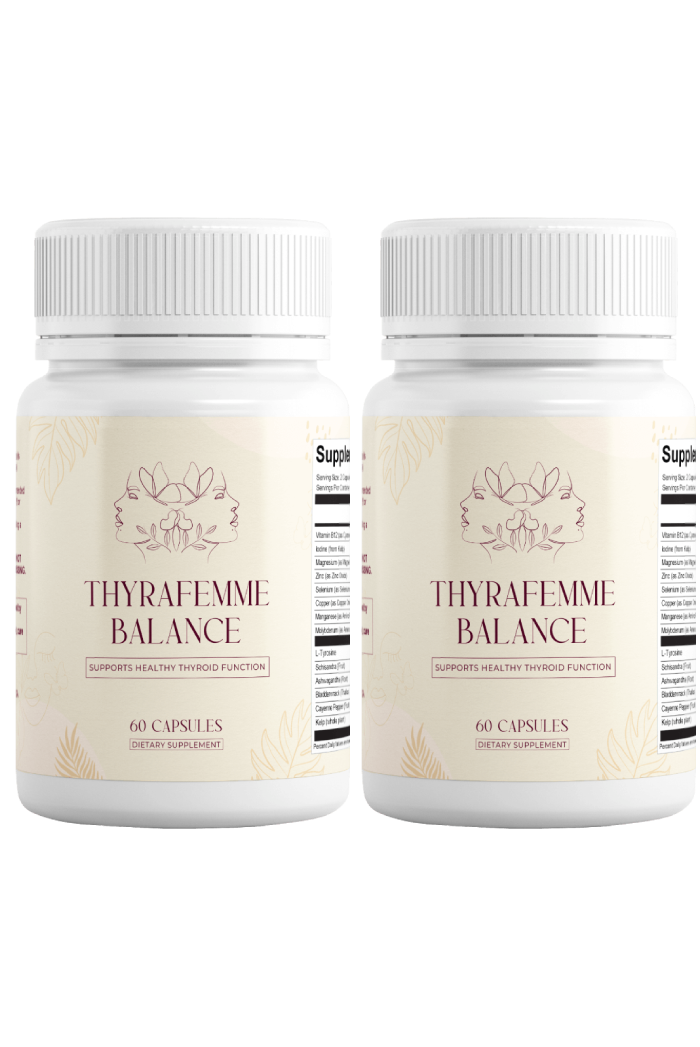
Product image published by the manufacturer.
A thyroid condition is a medical diagnosis that requires a blood test and, usually, prescription treatment. No dietary supplement diagnoses, treats or corrects hypothyroidism, hyperthyroidism or Hashimoto's, and none is a substitute for prescribed thyroid hormone or any other thyroid medication.
If you have symptoms you think are thyroid-related — fatigue, weight change, hair loss, cold sensitivity, brain fog — the useful first step is a TSH blood test from your doctor, not a supplement. Those symptoms have many possible causes, several of them treatable, and a supplement that delays a diagnosis is worse than no supplement at all.
How we assessed this product
This is desk research. We read what the manufacturer publishes on its official website and looked at what is generally known about the nutrients involved in thyroid function. We received no samples, ran no tests and surveyed no users.
We do not publish star ratings on supplements, because a score implies a measurement we have not made. We also could not complete this review as thoroughly as we would like, for a reason covered in the next section.
Quick facts
| Product type | Daily dietary supplement marketed for women's thyroid and metabolic support |
|---|---|
| Stated composition | 14 vitamins, minerals and botanical extracts, per the manufacturer |
| Full label published? | No. The official page states the ingredient count and describes categories, but does not publish a complete Supplement Facts panel with amounts |
| Where it's sold | Manufacturer's official website only, with checkout handled by the seller |
| Price at time of writing | Sold in packages: 2 bottles $158 ($79 each), 3 bottles $177 ($59 each), 6 bottles $294 ($49 each). Verify current pricing on the official site |
| Shipping | Free shipping on the 3- and 6-bottle packages, per the seller. The 2-bottle package carries a small shipping fee |
| Guarantee | 60-day money-back guarantee stated by the seller and administered by the seller. Read the exact terms on the official site before ordering |
| Do not take without medical advice if | You take any thyroid medication, have Hashimoto's or Graves' disease, are pregnant or nursing, or have a scheduled blood test |
The single most important thing we can tell you about this product is what we could not find out. The manufacturer states that Thyrafemme Balance contains fourteen ingredients and groups them into broad categories — B-complex vitamins, trace minerals, botanical extracts and an antioxidant blend — but does not publish a full Supplement Facts panel naming each ingredient with its amount.
For most supplement categories that would be a mark against a product. For a thyroid formula it is a more serious gap, because the specific identity and dose of several ingredients commonly used in this category determine whether the product is safe for a given person. Iodine is the clearest example: the right amount supports thyroid hormone production, and too much can worsen autoimmune thyroid disease. Selenium has a genuinely narrow window between useful and toxic. Biotin, at the doses common in hair-and-thyroid formulas, interferes with the blood test your doctor uses to assess your thyroid.
None of that can be evaluated from a category name. So our practical advice is simple: before ordering, ask the seller for a photograph of the actual Supplement Facts panel, and take that panel to your doctor or pharmacist. If a seller will not provide the label for a product intended to be taken daily, that in itself tells you something worth knowing. Our guide on how to read a supplement label shows what to check once you have it.
Based on the categories the manufacturer describes, these are the nutrient groups involved and what is actually established about each in relation to thyroid function.
Described by the manufacturer as core vitamins in the formula. B vitamins are cofactors in energy metabolism generally.
Evidence note: correcting a genuine B12 deficiency can improve fatigue, and B12 deficiency is more common in people with autoimmune thyroid disease. In people who are not deficient, extra B vitamins do not improve thyroid function. A blood test tells you whether you are in the first group.
The category most likely to include iodine, selenium and zinc, which are the minerals genuinely involved in thyroid hormone synthesis and conversion.
Evidence note: these matter most in deficiency. In iodine-sufficient countries, which includes most of the US and Western Europe, adding iodine is more likely to cause a problem than solve one, particularly in Hashimoto's. Amounts are not disclosed here, which is why we cannot assess this.
Thyroid formulas in this category commonly use ashwagandha, guggul, bladderwrack or similar herbs.
Evidence note: the human evidence is limited and mostly small trials. Ashwagandha in particular can raise thyroid hormone levels, which is a problem rather than a benefit if you are already medicated, and bladderwrack is a concentrated iodine source. Without the label, you cannot know which of these you are taking.
A general supporting category rather than a thyroid-specific one.
Evidence note: antioxidant supplementation has not been shown to change thyroid function. This is reasonable general nutrition, not a mechanism by which a thyroid problem would improve.
The honest summary of the evidence
There is no published clinical trial of Thyrafemme Balance. The nutrients involved in thyroid function are real and well understood, but they help people who are deficient in them — and the only way to know whether you are deficient is a blood test. For a woman with normal thyroid labs and adequate nutrition, there is no good reason to expect this formula to change how she feels. For a woman with an actual thyroid condition, it is not a treatment. That leaves a fairly narrow group of people for whom it might do something, and no way to identify yourself as one of them without seeing a doctor first.
1. Biotin distorts thyroid blood tests. Biotin is standard in formulas that mention hair and skin, and at supplement doses it interferes with the immunoassays laboratories use to measure TSH, T4 and T3. It does not change your thyroid — it changes the number on the report, and the distortion can look like an overactive thyroid. People have been misdiagnosed and treated on the strength of biotin-skewed results. Standard clinical guidance is to stop biotin for at least two days, and preferably longer, before a thyroid blood test, and to tell the laboratory you have been taking it.
2. Minerals block the absorption of thyroid hormone medication. Calcium, iron, magnesium and zinc all bind prescribed thyroid hormone tablets in the gut and reduce how much you absorb. If you take thyroid medication and start a mineral-containing supplement without separating the doses, your thyroid levels can drift out of range over the following weeks. The usual guidance is a gap of at least four hours, and to have your levels rechecked after any change to what you take daily.
Take the actual label to your doctor or pharmacist before your first dose. With a thyroid formula this is not a formality — it is the difference between a supplement being harmless and it quietly interfering with your treatment or your diagnosis.
At the time of writing the manufacturer sells Thyrafemme Balance in packages: two bottles for $158 ($79 each), three for $177 ($59 each) and six for $294 ($49 each). The realistic entry cost is therefore $158, and the pricing is structured to push you toward the larger packages.
Shipping is free on the 3- and 6-bottle packages, according to the seller; the 2-bottle package carries a small shipping fee. The seller shows a list price of $99 per bottle, so compared with that price the saving on the bottles themselves is $40 on two, $120 on three and $300 on six. The official order page advertises larger “savings” of $302 and $434 on the 3- and 6-bottle packages. Those figures appear to include the value the seller assigns to the bonus e-books bundled with those orders, so we quote the bottle-only numbers here.
A 60-day money-back guarantee is stated by the seller. It is offered and administered by the seller, not by us — we have no role in refunds and no influence over the outcome. Read the exact terms on the official site before you order, keep your order confirmation, and start any refund request well inside the window rather than at the end of it.
Affiliate link. Pricing and shipping terms above were accurate on 28 September 2026 and may have changed.
Independent references we used to check the claims on this page. They describe the ingredients and tests in general, not this specific product.
No. Prescribed thyroid hormone replaces a hormone your body is not making enough of. A dietary supplement does not do that, and stopping or reducing prescribed thyroid medication without medical supervision is dangerous. If you want to discuss your treatment, that conversation belongs with the doctor who prescribes it.
Possibly, and this is worth taking seriously. If the formula contains biotin — which is likely given it is marketed partly for hair and skin — it can distort TSH, T4 and T3 results on standard laboratory assays. Tell your doctor and the laboratory what you are taking, and follow their advice on stopping it before a test.
Ask the seller's customer support for a photograph of the Supplement Facts panel before you order. Any legitimate supplement company can produce this immediately. We would not start a daily product without it, and we would treat reluctance to provide it as an answer in itself.
There is no established timeline, because there is no published trial of this product. If a nutrient deficiency is being corrected, changes typically take weeks to months. If no deficiency exists, there may be nothing to notice. Decide in advance how long you will give it and what improvement would actually look like, and use the refund window if you get there with nothing.
We cannot recommend a daily supplement whose full ingredient label is not published, and for a thyroid formula that is not a technicality. Iodine, selenium and biotin all have real consequences at the wrong dose or in the wrong person, and none of those can be assessed from a category description.
Setting that aside, the underlying idea is not unreasonable. Nutrients involved in thyroid hormone production are real, and correcting a genuine deficiency can make a difference. But that is a case for a blood test and a targeted supplement, not for a fourteen-ingredient blend taken speculatively at $49 to $79 a bottle.
If you have thyroid symptoms, get a TSH test. If your labs are normal and you still want to try this, get the actual label first, show it to a pharmacist, and go in understanding that no result is promised. That is the honest version, and it is the same advice we would give a friend.
Affiliate link. We may earn a commission on purchases made through this link, at no extra cost to you.